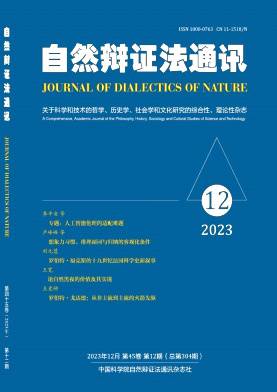
Published Online: 10 November 2023
DOI: 10.15994/j.1000-0763.2023.12.004
Abstract: The Grue Problem means that the empirically identical and logically equivalent statements of evidence can inductively support the logically conflicting statements of hypotheses, which is essentially an intuition confusion rather than a logic paradox. The resolution of the conflict between single preference intuition and equal preference intuition relies on the clarification of Hume’s “imagination habit”. The existing asymmetrical solution attaches new mental habits to the “conditional sentence of imaginative habit”, avoiding hypothetical conflicts by explaining the single preference intuition. The symmetry solution which is achieved through the complementarity principle affirms the equal preference intuition and resolves the conflicts of hypotheses. The advancement is attributed to the methodological improvement made from the conceptual reflection on inductive intuitions to the language analysis of inductive adverbs. The meaning of induction of reasoning adverbs contains the logical form of necessity operation and the semantic content of objectifying condition, a portrayal of the general structure of imagination habits.
Key Words: Grue problem; Imagination habit; Reasoning adverb; Objectifying condition; Complementarity principle
- Contact Us
- Address: No.19A Yuquan Road, Beijing, 100049, China
- Phone: +86-10-88256007
- Email:jdn@ucas.ac.cn